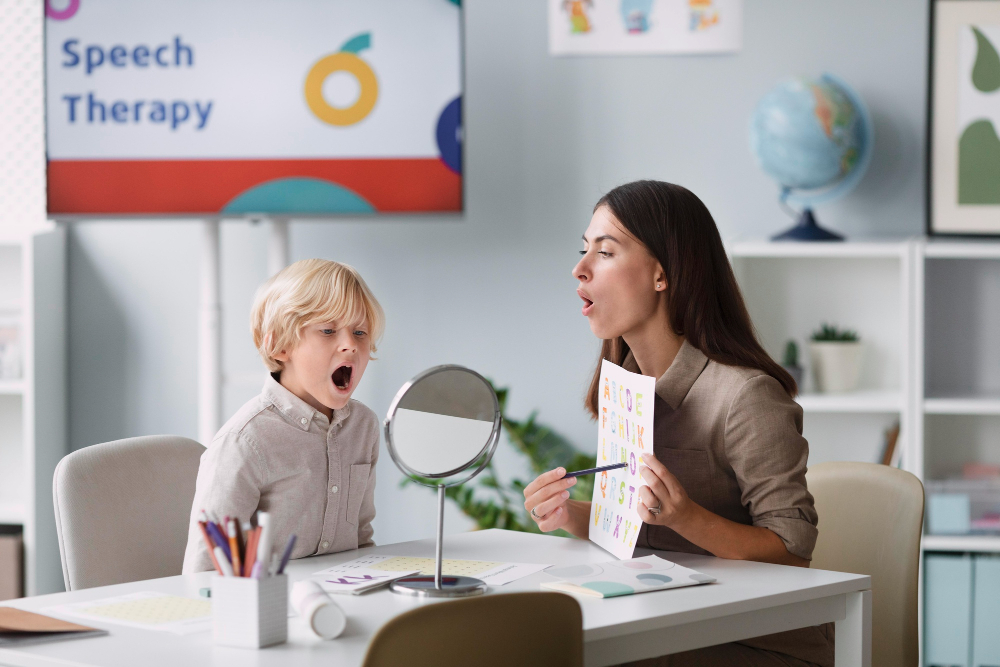

Apraxia speech therapy is the specialised treatment for Childhood Apraxia of Speech (CAS) — a motor speech disorder where a child knows what they want to say but the brain has difficulty planning and coordinating the precise movements needed to say it. It is a relatively rare condition, affecting roughly 1 to 2 children in every 1,000, and it requires a specific therapy approach that is different from how a typical speech delay is treated.
Because CAS often looks like a general speech delay or “late talking” at first, it is frequently missed or misdiagnosed. Getting the right diagnosis matters, because the wrong therapy approach can stall progress for months.
What is Childhood Apraxia of Speech?
CAS is a neurological motor speech disorder. The muscles for speech work fine — the issue is the brain’s ability to plan and sequence the movements those muscles need to make. A child with CAS has the language, the ideas, and often the desire to communicate, but turning intention into accurate sound is hard and inconsistent.
The American Speech-Language-Hearing Association identifies three core features clinicians look for:
- Inconsistent errors on the same word — saying “banana” three different ways in five minutes.
- Disrupted transitions between sounds and syllables — segmented or “robotic” speech.
- Inappropriate prosody — flat or unusual stress and intonation.
These features set CAS apart from other speech sound difficulties and guide the therapy approach.
Signs of apraxia in young children
CAS often shows up early but can be hard to identify until a child is making more attempts at words. Common indicators include:
- Late babbling, or limited variety in babbling.
- First words appearing very late or being lost (regression).
- Quiet child who appears to understand much more than they say.
- Vowel errors — vowels are usually one of the easier elements of speech, so consistent vowel distortion is a flag.
- Words pronounced differently every time.
- Visible groping — moving the mouth and lips searching for the right position before speaking.
- Speech that gets harder, not easier, as words get longer.
A child can be a “late talker” without having CAS, and many late talkers catch up without specialist help. But late talking combined with these specific patterns warrants a CAS-aware assessment.
How CAS differs from other speech delays
This distinction is the single most important thing for parents to understand:
- A phonological disorder is a pattern problem — the child consistently substitutes one sound for another (e.g., always says “tat” for “cat”). It responds well to traditional speech sound therapy.
- An articulation disorder is difficulty producing one or two specific sounds. It also responds well to standard articulation therapy.
- CAS is a motor planning problem. Errors are inconsistent and the child needs a different therapy method that focuses on movement sequences, repetition, and motor learning principles — not on individual sounds.
If your concern is general clarity rather than CAS specifically, our guide to unclear speech in children walks through the wider category.
How is CAS diagnosed?
Diagnosis requires a speech pathologist with experience in motor speech disorders. The assessment is detailed and usually includes:
- Detailed case history, including developmental milestones and family history.
- Oral motor examination.
- Speech sample — single words, repeated words, longer utterances, and connected speech.
- Tasks designed to elicit the specific features of CAS (consistency, prosody, transitions).
- Hearing screening to rule out hearing as a contributing factor.
Diagnosis can be tentative under age 3, because some features only become observable as the child attempts more complex speech. A skilled clinician will often start therapy with a working hypothesis and refine the diagnosis as the child responds.
Evidence-based apraxia speech therapy approaches
Treatment for CAS is built around motor learning principles: high repetition, careful sequencing, multisensory cueing, and gradually increasing complexity.
Dynamic Temporal and Tactile Cueing (DTTC)
One of the most widely used and well-researched approaches for CAS. The clinician uses simultaneous production, mouthing, and fading of cues to help the child build accurate motor plans, with intensity adjusted to the child’s success.
Rapid Syllable Transition Treatment (ReST)
Developed at the University of Sydney, ReST uses non-words to target the smooth transition between syllables — a core CAS difficulty. Strong evidence for school-age children with mild to moderate CAS.
Nuffield Dyspraxia Programme (NDP3)
A structured, hierarchical program that builds up from single sounds to connected speech, working systematically on the building blocks of speech motor planning.
PROMPT
A tactile-kinaesthetic approach where the clinician provides physical cues to the jaw, lips, and face to guide accurate movement. Requires specifically trained clinicians.
How often and how long does therapy take?
CAS responds best to high-intensity, frequent therapy. Research suggests 3–4 sessions per week is more effective than 1 weekly session for younger children with severe CAS, though a practical balance is usually negotiated based on family resources and funding.
Therapy is often long-term. Children with CAS make real progress, but they typically need ongoing support over years, with goals shifting from intelligibility in single words, to phrases, to connected speech, and eventually to literacy and confidence.
Supporting your child at home
- Practise daily in short bursts — motor learning is built by frequency, not session length.
- Follow your therapist’s home program closely; precise repetition matters more than volume.
- Use visual and tactile cues your therapist has trained you in.
- Keep communication motivating — give your child non-verbal ways to express themselves so they don’t become frustrated or shut down.
- Celebrate effort, not just accuracy.
Frequently asked questions
Is CAS the same as autism?
No. CAS is a motor speech disorder. Some autistic children also have CAS, but the two are separate conditions and can occur independently.
Will my child speak normally one day?
Many children with CAS achieve fully intelligible, age-appropriate speech with sufficient therapy. Outcomes depend on severity, co-occurring conditions, and therapy intensity.
Can CAS be cured?
“Cure” isn’t the right word — CAS is a motor learning difference, not an illness. With the right therapy, however, most children develop functional, clear speech.
Should we use sign language or AAC while we work on speech?
Yes, often. Giving a child a reliable way to communicate while their speech catches up reduces frustration and supports — not slows — speech development. Your speech pathologist can advise.
How is this different from a child who is just a late talker?
Many late talkers don’t have CAS — they have a delay that resolves with general support. CAS is a specific motor planning issue. You can read more about the broader category on our delayed speech and late talking children page.
What if my child also stutters?
CAS and stuttering can co-occur and need to be managed thoughtfully. See our overview of stuttering therapy for children for how that side is approached.